
Check My Symptoms
Many people use their GP as their first port of call whenever they have any health problems. But often they could have received the necessary care somewhere else, freeing up valuable GP appointments for those who really need to see a GP. Worse still, some patients try to make an appointment with a GP when they should really be seeking urgent emergency care, via A&E or calling 999. Click here for more information. To check your symptoms on the NHS Symptom Checker, click the image below.

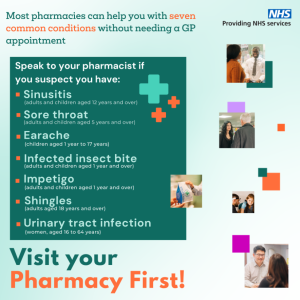
You can visit your pharmacist for a consultation and they will treat you and prescribe medicines if necessary. If your condition is more serious you will be referred to a GP or hospital.
Your pharmacist will asses your suitability for treating you and may refer you to another health service if they feel it’s more appropriate.
There are many other conditions which you can also see your pharmacist about rather than your doctor. These include:
- Aches and pains – such as, back pain, headache and period pain.
- Accidents – such as, sprains, minor cuts, and grazes
- Colds, flu and other infections – such as, cough, congestion, fevers and/or temperature.
- Ear care – such as, ear wax.
- Eye care – such as, conjunctivitis, styes.
- Hay fever – which is not controlled by standard over-the-counter treatments.
- Rashes.
- Skin problems – such as, athlete’s foot, cold sores, or mild eczema or psoriasis.
- Stomach aches – such as, constipation, diarrhoea, or indigestion.
How to see your pharmacist
More than 10,000 pharmacies across the UK are part of the scheme – that’s more than 9 out of every 10. Generally, you can just walk in to your closest or preferred one and ask for an appointment – or they will see you straightaway if there is availability. If you’d prefer, you can call and ask for a video consultation with the pharmacist.
You may also be referred to a pharmacy appointment from:
- NHS 111 – online, telephone and the NHS App.
- Integrated urgent care clinical assessment services.
- Urgent treatment centres.
- A&E.
- 999.
- Your GP.
To find out your nearest pharmacy and check if it is part of the scheme go to NHS pharmacy finder or just walk in.
What will happen at your pharmacist appointment
Your consultation with the pharmacist will always be confidential and in a private place. The pharmacist will ask you questions about your health – they may need to know about your previous medical history, any allergies, any medicines you are taking, and the symptoms you are experiencing. They will ask you before checking any medical records.
For some conditions, the pharmacist may ask to have a look at what is wrong – for instance, if you have an earache, they may use an otoscope to look into your ear. The pharmacist will not use diagnostic tests to check for specific conditions – such as checking a pee sample for a UTI or swabbing your sore throat.
The pharmacist will recommend the best course of action to treat your condition – this could be that your illness is best to run its course, they may prescribe medication such as antibiotics. If your condition is more severe they may refer you to another health service or professional.
The notes of your consultation will be added to your medical records.
What else can you see a pharmacist about
As well as the conditions covered under Pharmacy First and other minor illnesses, there are many other issues and topics your pharmacist will be able to help you with, these include:
- Advice on using and disposing of medicines.
- Contraception.
- Blood pressure checks.
- Chlamydia screening and treatment.
- Quitting smoking.
- Cholesterol and blood sugar testing.
- Drug use – including needle and syringe exchange schemes.
- Help on how to manage your weight.
- Some vaccinations.
Please note different pharmacies will provide different services. It is best to check with your local pharmacy before taking the trip to make sure they provide the service you require.
